
Languages
HAUTE-GARONNE
Showing 2 of 2 accommodations
The Bivo Moto community is building the motorcycle accommodation map
Do you know a hotel, guesthouse or campsite suited for motorcycle travelers in this area? Share it and help other riders plan their next road trips.
Recommend an establishmentHaute-Garonne lays out a landscape made for riding. From the plains around Toulouse in the north to the high passes of the central Pyrenees in the south, this department delivers an incredibly diverse playground. You've got hilltop medieval bastides, ridge roads overlooking the Garonne valley, and those legendary Tour de France cols that lead all the way to the Spanish border. The Comminges region alone packs in an exceptional amount of history, with Saint-Bertrand perched on its rocky outcrop and Luchon throwing open the doors to the high mountains. The backroads of the Volvestre wind through rolling hills with the Pyrenees on the horizon, while the Lauragais spreads its bastide towns along the Canal du Midi. A department of contrasts where every mile reveals something new — from the pink brick of Toulouse to the grey stone of the mountain summits.
Terrain
Plains → Pyrenees
Heritage
7 UNESCO sites
Riding roads
Legendary passes
You can't ride through without stopping in Toulouse — the pink city with its Occitan brick, the Basilica of Saint-Sernin, and the Cité de l'Espace for anyone with a passion for aerospace. But it's to the south that the department reveals its most spectacular treasures. Saint-Bertrand-de-Comminges, ranked among the Most Beautiful Villages in France, lords over the valley from its rocky promontory, crowned by the UNESCO-listed Sainte-Marie cathedral. The Gallo-Roman ruins of Lugdunum Convenarum tell two thousand years of history. Further along, Bagnères-de-Luchon — nicknamed the Queen of the Pyrenees — opens the door to stunning mountain lakes like Lac d'Oô. The Canal du Midi winds eastward, passing medieval bastide towns like Revel and Saint-Félix-Lauragais. The châteaux of Laréole and Valmirande, the Gallo-Roman villa of Montmaurin, and the villages of Martres-Tolosane and Saint-Martory along the Garonne round out a heritage scene of rare richness.
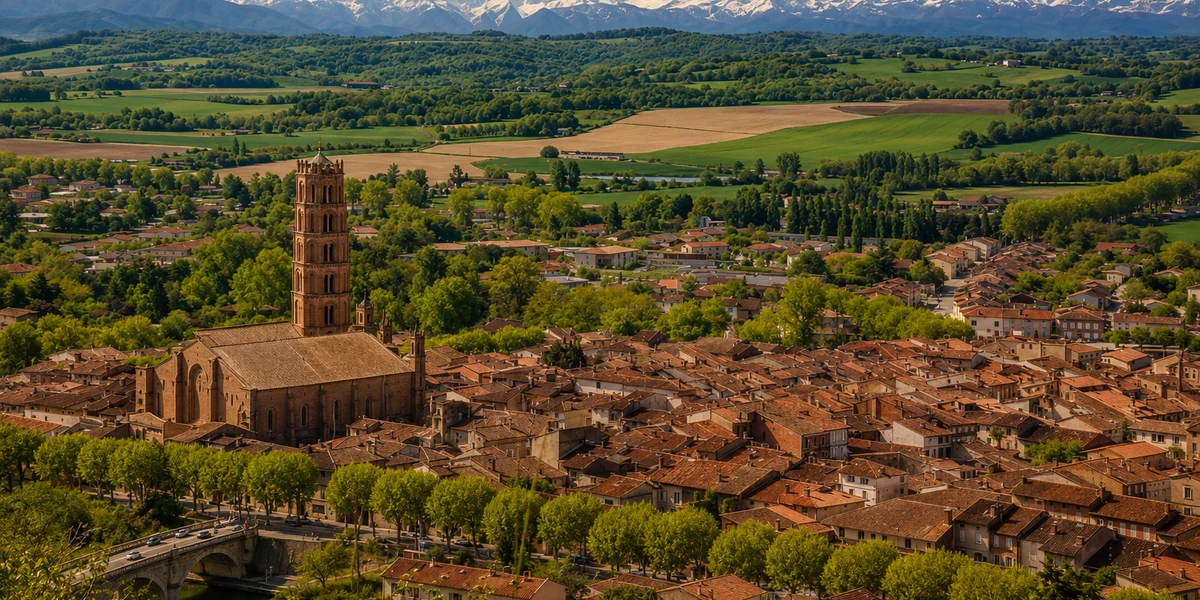
Perched medieval village, UNESCO cathedral, and Gallo-Roman ruins of Lugdunum Convenarum.
Spa town and Queen of the Pyrenees, gateway to the high-altitude passes and mountain lakes.
The largest Romanesque church in France and a major stop on the pilgrimage routes to Compostela.
Stunning mountain lake at 4,900 feet, with a waterfall and glacial cirque.
A 17th-century UNESCO-listed waterway linking the Garonne to the Mediterranean.
16th-century Renaissance château surrounded by 62 acres of gardens and parkland.
A vast ancient villa complete with thermal baths, one of the finest of its kind in France.
A 12th-century Romanesque church standing alone in the plain, with exceptional architecture.
Theme park dedicated to space and aerospace, with a planetarium and an Ariane rocket.
14th-century royal bastide, famous for its Saturday market — one of the finest in France.
Fortified village overlooking the Lauragais, with sweeping views over the plain and the Pyrenees.
Wild gorges in the Pyrenean foothills, a well-preserved natural site.
Riverside village on the Garonne, known for its faience pottery tradition and half-timbered houses.
13th-century bastide with a medieval bridge and a 17th-century château overlooking the Garonne.
Former royal bastide at the confluence of the Neste and the Garonne, with panoramic views.
Village home to a Prehistory museum and the eponymous Upper Paleolithic site.
Glacial valley leading from Luchon into pastoral refuges and high mountain scenery.
Trailhead for hikes to mountain lakes and the Spanish border.
Haute-Garonne is home to some of the finest motorcycle roads in the central Pyrenees. The Col de Peyresourde, at 5,150 feet, follows the D618 between Luchon and Arreau, marking the border with the Hautes-Pyrénées. Its smooth bends and panoramic views of the surrounding summits have made it a legendary Tour de France climb. The Col de Menté, with its string of tight hairpins, connects Luchon to Portet-d'Aspet via the D44 and then the D618. Further north, the Volvestre roads offer rolling ridge runs along the D627 between Sainte-Croix-Volvestre and Saint-Girons, with the Pyrenees as a constant backdrop. Portet-d'Aspet itself, on the D618, is a technical and demanding pass that calls for respect. From Saint-Bertrand-de-Comminges, loops head toward the Col du Portillon and Spain, or wind through the Ariège valleys on quiet back roads. Valley routes like the N125 toward Luchon carve through spectacular scenery between Montréjeau and the border, while the small departmental roads of the Comminges keep stacking up viewpoints over the Pyrenean chain.
At 5,150 ft, a legendary Tour de France pass between Luchon and the Louron valley.
A spectacular sequence of hairpins from Luchon — technical and scenic all the way to Portet-d'Aspet.
A demanding pass between Saint-Girons and Saint-Gaudens, a cult stage on the classic cols circuit.
The link between Luchon and the Val d'Aran in Spain, a panoramic road that opens right onto the border.
16 miles between Sainte-Croix-Volvestre and Saint-Girons, rolling ridges with the Pyrenees dead ahead.
The Montréjeau–Luchon corridor, a tight valley with summit views as you close in on the border.
A circuit starting from Saint-Bertrand, rolling roads between the Garonne, the Neste, and the Pyrenean foothills.
34 miles of curves through valleys and passes, a smooth connection between Haute-Garonne and Ariège.