
Languages
GARD
Showing 2 of 2 accommodations
The Bivo Moto community is building the motorcycle accommodation map
Do you know a hotel, guesthouse or campsite suited for motorcycle travelers in this area? Share it and help other riders plan their next road trips.
Recommend an establishmentOn one side, the Mediterranean and the Gardoise Camargue, with its wild beaches and luminous expanses. On the other, the Cévennes highlands rising up to Mont Aigoual, the department's highest point at 1,567 metres. In between, an exceptional concentration of Roman heritage: the Nîmes amphitheatre, the Pont du Gard, medieval villages perched above the gorges. On a motorcycle, the Gard is experienced as much through its roads as through its stops. The Corniche des Cévennes, the Gardon gorges, the arid causse plateaus: each stretch has its own character, its own light, its own relief. Here, you ride as much for the heritage as for the bends.
Relief
From the Camargue to Mont Aigoual
Heritage
Roman & Medieval
Roads
Ridgelines, causse plateaus and valleys
The Gard brings several worlds together in a single department. In Nîmes, the Roman amphitheatre and the Maison Carrée bear witness to the power of the Empire, with the Musée de la Romanité rounding out the visit. The Pont du Gard, a masterpiece of ancient engineering and a UNESCO site, rewards a stroll along its banks before a swim in the Gardon. Uzès, France's first ducal town, charms with its cobbled lanes, Saturday market and château. On the nature side, the Cévennes offer the Bambouseraie d'Anduze, the wild gorges of the Gardon and the Vis, and the Cirque de Navacelles, a vertiginous geological cleft. Further south, the Gardoise Camargue with its Espiguette beaches, Aigues-Mortes and its medieval ramparts, and the pink salt marshes. Between fragrant garrigue, hilltop villages such as Aiguèze and Lussan, spectacular caves (Trabuc, Salamandre) and local produce (pélardon cheese, Costières wine, brandade), the Gard has mastered the art of blending heritage with authenticity.
The best-preserved Roman amphitheatre in the world, still in use for shows and ferias.
France's first duchy, medieval lanes, Provençal market and ducal château.
A unique exotic garden in Europe, forest of giant bamboo and a zen atmosphere.
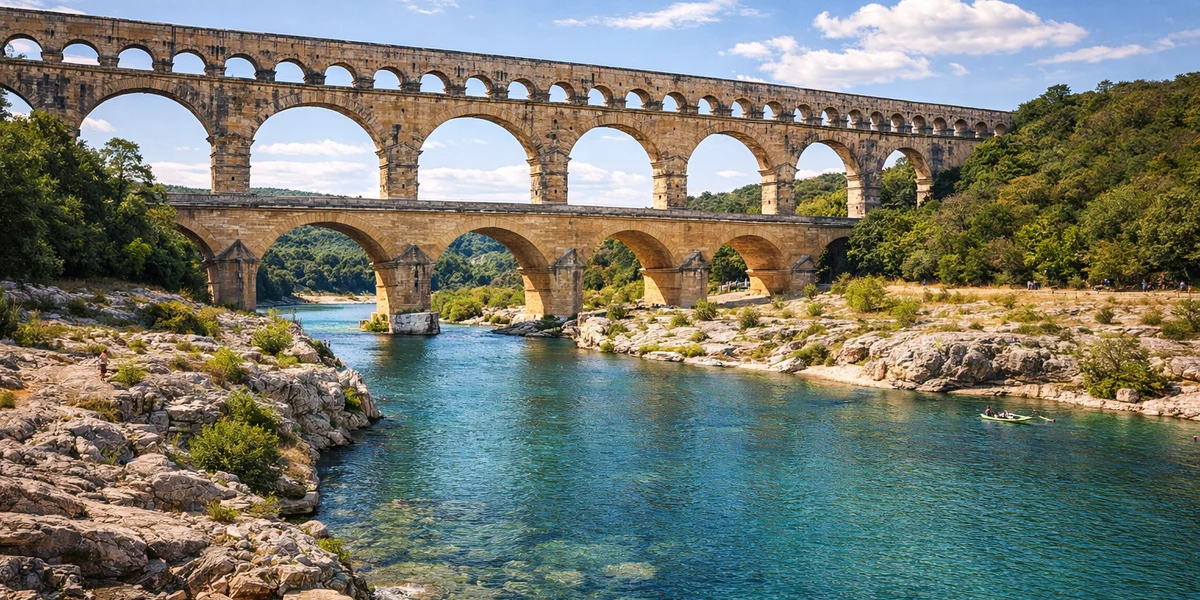
Three-tiered Roman aqueduct, UNESCO World Heritage Site, towering over the Gardon river.
Spectacular canyon carved by the Vis river, Grand Site de France with vertiginous landscapes.
The Gard's highest peak at 1,567m, exceptional panoramic views and historic weather station.
18 km of wild fine sand, preserved dunes and a panoramic century-old lighthouse.
Fortified medieval town, fully intact ramparts, gateway to the Gardoise Camargue.
Perched medieval village overlooking the Sautadet waterfalls. One of the most beautiful in the Gard.
The only fully preserved Roman temple, an exceptional example of ancient architecture.
UNESCO biosphere reserve, protected dark sky, preserved biodiversity.
The largest underground network in the Cévennes, featuring mysterious petrified soldiers.
The Gard offers a rare range of motorcycle routes, from the coast to the summits. The Corniche des Cévennes (D260 then D9) remains the undisputed classic: 50 km between Saint-Jean-du-Gard and Florac, flowing bends, impeccable road surface and panoramic views over the Cévennes valleys. The climb to Mont Aigoual via the D986 or D18 delivers elevation gain and clear views all the way to the Mediterranean. The Gardon gorges can be ridden along the D981, a winding road hugging the water between limestone cliffs. To the north, the causse roads (D979, D7) cross arid, deserted plateaus — a guaranteed mineral atmosphere. The Uzès area is packed with small departmental roads through the garrigue: D982, D3, D22, perfect for linking hilltop villages and vineyards. The Cèze gorges (D980, D143) lead to La Roque-sur-Cèze and the Sautadet waterfalls. On the Camargue side, the D58 and D62b run alongside lagoons and salt marshes all the way to the Espiguette. The Gard lends itself equally to leisurely rides and demanding days in the Cévennes mountains.
From Nîmes, the D112 follows the Gardon upstream between limestone cliffs and garrigue to the Pont du Gard site. The D135 on the Collias and Russan side offers the finest viewpoints over the river in a wild, uncrowded setting.
Between Alès and Florac, the D907 then the D9 cross the heart of the Cévennes along winding forest roads with significant changes in altitude. The Bambouseraie de Prafrance, schist villages and wooded passes punctuate the route.
The ascent to the Aigoual summit via the D986 from Le Vigan is one of the most panoramic roads in the southern Massif Central. In clear weather, the view from the observatory stretches as far as the Mediterranean and the Pyrenees.
From Uzès, the D981 and D23 link golden-stone villages, fragrant garrigue and the Pont du Gard in a very accessible loop. Towards Saint-Quentin-la-Poterie and Castillon-du-Gard, the roads remain quiet and the scenery well-kept.
From Aigues-Mortes, the flat roads of the Gardoise Camargue run alongside lagoons, marshes and rice paddies in a wild and luminous atmosphere. The D179 towards Le Grau-du-Roi and Saint-Gilles offers a completely different experience from the rest of the department, ideal for closing a loop from Nîmes.