
Languages
AVEYRON
Showing 3 of 3 accommodations
The Bivo Moto community is building the motorcycle accommodation map
Do you know a hotel, guesthouse or campsite suited for motorcycle travelers in this area? Share it and help other riders plan their next road trips.
Recommend an establishmentAveyron covers nearly 9,000 km² of highly diverse landscapes, from the Aubrac plateau in the north to the Larzac plateaus in the south, via the Lévézou and its lakes, and the gorges of the Tarn, Jonte, and Dourbie cutting through the limestone plateaus. Between Millau and Rodez, the scenery shifts between limestone steppes, green valleys, deep forests, and the red lands of the Rougier. This preserved part of the Massif Central offers an exceptional network of winding secondary roads, sometimes flowing across plateaus, sometimes more technical through the gorges. Medieval villages such as Conques with its stained glass by Soulages, bastide towns, the Templar sites of the Larzac, and the Roquefort caves naturally shape each stage of the journey. It is one of the richest departments in characterful roads in the Massif Central, with little traffic and constantly changing scenery.
Relief
Causses, Aubrac, Lévézou, from limestone plateaus to high altitude pastures
Gorges
Tarn, Jonte, Dourbie, canyons with roads carved into the cliffs
Villages
Most Beautiful Villages of France, national record with 10 listed villages
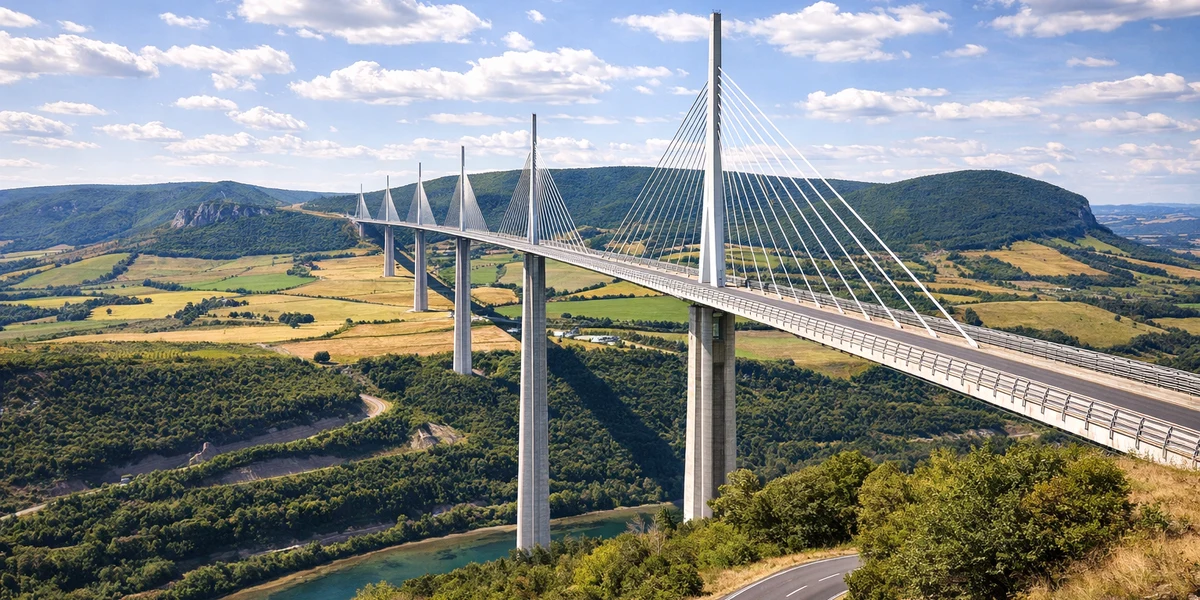
Aveyron is home to ten villages listed among the most beautiful in France, a national record. Conques and its Romanesque abbey with stained glass by Pierre Soulages, Belcastel and its restored castle, La Couvertoirade, a Templar town, and Estaing on the Way of Saint James are all highlights. Rodez features its pink sandstone cathedral and the Soulages Museum, while Millau stands out with its spectacular viaduct overlooking the Tarn valley. The Tarn, Jonte, and Dourbie gorges offer dramatic views of cliffs inhabited by reintroduced vultures. The rock formations of Montpellier le Vieux and the Bozouls canyon are also worth visiting, along with the Larzac plateau, listed by UNESCO, and the Lévézou lakes for a relaxing break. To the north, the Aubrac plateau with its pastures dotted with traditional stone huts completes the landscape. Local gastronomy is another highlight, with Roquefort caves, aligot from Laguiole, the famous knife of the same name, and farmers’ markets showcasing the richness of Aveyron’s terroir.
Tallest bridge in the world, 343 meters above the Tarn, designed by Norman Foster, with accessible viewpoints.
World famous cheese matured in the village’s natural caves, with guided tours and tastings.
Romanesque masterpiece on the Way of Saint James, with a sculpted Last Judgment tympanum and contemporary stained glass by Pierre Soulages.
Fortified Templar village from the 12th century on the Larzac plateau, with intact ramparts, cobbled streets, and preserved architecture.
Vast volcanic plateau of 2,500 km², high altitude pastures, Aubrac cattle, traditional stone huts, and Lake des Moines at 1,300 meters.
Stone city with spectacular rock formations across 120 hectares, marked trails, tourist train, and via ferrata.
Five artificial lakes including Lake Pareloup, offering swimming, sailing, fishing, beaches, and mid mountain scenery.
Gothic cathedral in pink sandstone, 87 meter bell tower, built over three centuries, with views over the town and plateaus.
Visit the workshops where the famous Laguiole knife is made, with demonstrations, shop, and traditional craftsmanship.
Medieval village on the Aveyron river, with a 15th century castle and Gothic bridge, listed among the most beautiful villages in France.
Green gorges between Causse Noir and Larzac, with perched villages such as Cantobre and Saint Véran, and a winding 18 km road.
Narrow canyon between Causse Méjean and Causse Noir, home to vultures, with viewpoints and the Vulture Center.
Aveyron offers an outstanding playground with roads shaped by the relief of the Massif Central. The Tarn gorges can be followed via the D907bis, a legendary road clinging to the cliffs between Le Rozier and Sainte-Énimie, with an extension to the Jonte gorges via the D996 to Meyrueis. The Dourbie gorges are explored via the D991 between Nant and Millau, a winding and shaded route. The Larzac plateau loop via the D999 crosses wide open limestone landscapes, with detours to La Couvertoirade and Sainte-Eulalie via the D7. The Aubrac plateau is best discovered via the D533 between Laguiole and Nasbinals, a flowing road across high altitude pastures. The D911 connects Rodez to Espalion through the red landscapes of Marcillac. The Lévézou lakes can be circled via the D23 and D577, offering rolling terrain between forests and viewpoints. All these routes can be combined to extend into Tarn, Lozère, Cantal, or Hérault.
From Le Rozier, the D907bis runs through the Tarn gorges between towering cliffs, tunnels carved into the rock, and scenic viewpoints. At Le Rozier, turn onto the D996 towards Meyrueis for the Jonte gorges, a spectacular route with views of vultures and rock formations.
The D991 winds for 18 km between the Causse Noir and Larzac, following the river through shaded sections. Villages such as Cantobre and Saint Véran cling to the cliffs. A technical and refreshing ride in summer.
The D999 crosses the Larzac plateau from east to west, with vast open landscapes and detours to La Couvertoirade and Sainte Eulalie de Cernon via the D7. A unique atmosphere reminiscent of wide open western landscapes.
The D533 crosses the volcanic Aubrac plateau between 1,200 and 1,400 meters, with endless pastures, traditional stone huts, and Aubrac cattle. A smooth and panoramic route, with possible detours to nearby lakes.
A rolling circuit around the Lévézou lakes via the D23 and D577, through conifer forests and viewpoints over the water. A mix of flowing and more technical sections, ideal as a base to explore Millau and Rodez.